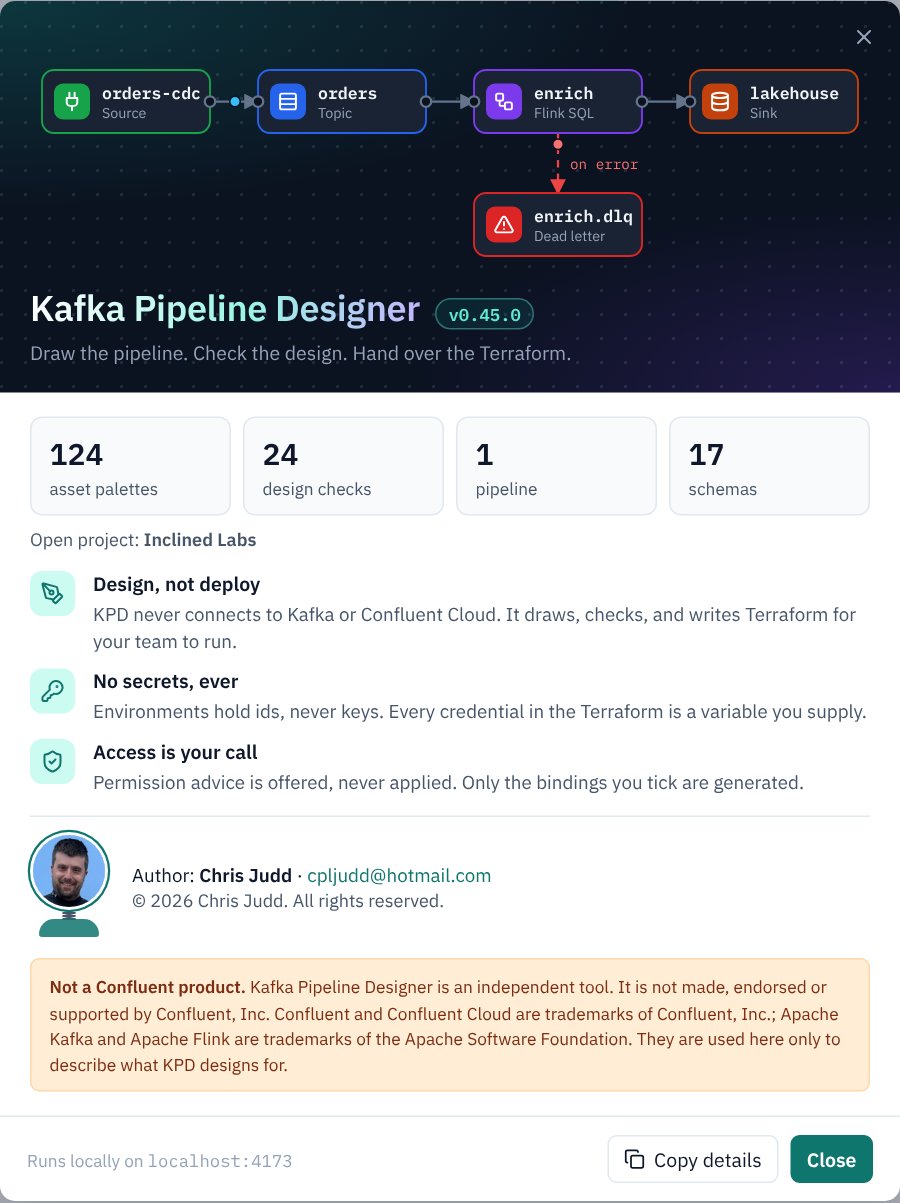
About, author and disclaimers
Who wrote KPD, what it is and is not, and the terms it comes with.

Why KPD exists
Designing event-driven data pipelines involves a lot of documentation. A design workshop produces a whiteboard diagram, then someone redraws it in a drawing tool, types the topic catalogue into a document, writes up the schemas, data quality rules, access model and governance tags, and finally a delivery team re-keys all of it into Terraform. Every copy drifts from the others.
KPD keeps one design and derives the rest from it. The diagram, the technical tables, the design document and the Terraform all come from the same project files, so they agree. Its style is inspired by the visual middleware and SOA design tools of the early 2000s: assets snap together on a canvas, and a properties panel underneath describes the selected asset.
Disclaimers
The name. KPD Studio was first called Kafka Pipeline Designer. It was renamed in v0.81.0 so that the product’s name no longer uses the Kafka trademark, which belongs to the Apache Software Foundation; “KPD” is simply the name now. Files keep their .kpd extensions.
- Design tool only. KPD never connects to Kafka, Confluent Cloud or any other system. It only reads and writes the project files you design.
- Generated output is a starting point. Terraform, Flink SQL, design documents and other exports are drafts for a qualified team to review, test and own. Check them against the current Confluent documentation and provider versions before use. Run Terraform in a non-production environment first.
- No warranty. KPD is provided as is, without warranty of any kind. The author is not liable for any loss arising from its use, including from deploying generated configuration.
- Security decisions are yours. KPD may suggest role bindings, but it never grants access by itself. Review every binding against your organisation's security policy.
- Credentials. KPD refuses to store API keys, secrets or passwords. If you find a way to put one in a project file, treat it as a bug and remove it.
- Client work. In the beta, projects are kept in a shared repository that everyone in the beta can open, so don’t put confidential client material in it. Use made-up names or the sample projects. The full rules for the beta are in the terms of use.
- Third-party logos. KPD ships no third-party logos. Palette icons are drawn for KPD; you may replace them with official artwork you are licensed to use.
Built with open-source software
React, React Flow, zustand, Vite and TypeScript in the browser; Express on a small server; Ajv, avsc and protobufjs for schema validation; JSZip and html-to-image for exports. The IBM Plex typefaces are used under the SIL Open Font License (licence).
The full list is in KPD under Help → Licence acknowledgements: every package KPD includes (about 130, most of them brought in by the ones above), with its version, licence, author, a link to the project and the licence text itself. Filter it by name or licence, or choose Save as text to keep every notice in one file. The same list is THIRD_PARTY_NOTICES.md in the KPD folder. Thank you to everyone who makes this software.
Contact
Questions, ideas and bug reports: cpljudd@hotmail.com. In the app, Help → About KPD shows the version and a Copy details button that copies the version and browser information, useful when you report a problem.